A working prototype is an important milestone. The idea is taking shape, the technology is producing results and you can show others what you have in mind. The excitement is justified. It also tends to raise a new question: when can we start selling?
My answer depends on what has already been demonstrated. For a product you can sell, you want to know that it meets the relevant requirements, withstands its intended use and can be manufactured consistently. Customers also need to be able to install and use it without the developer standing next to them.
These final steps contain work that is easy to overlook at the start. Much of it determines what the customer actually receives.

Use product-specific acceptance criteria; a successful demo covers only part of this.
Test for the environment the product will face
A successful demonstration tells you that something works at that moment. You also want to investigate how the product behaves during transport, daily use and the conditions it was designed for.
The tests required depend on the application. Vibration may be relevant to a device mounted on a machine. For a wearable, mechanical stress and exposure to moisture may matter. The test plan should reflect the usage requirements and the risks you have identified.
One method that can help is HALT, Highly Accelerated Life Testing. Products are exposed to increasing stresses, such as temperature and vibration, to uncover weaknesses. HALT alone does not establish an exact number of years of service life. Its main value is helping you understand where the design is vulnerable, so you can make targeted improvements and test further.
Address conformity during development
Certification is often treated as something to sort out at the end. That can cause delays if a test reveals that the design needs to change. Investigate the applicable requirements early, along with the design choices that affect them.
For products that require CE marking, the manufacturer must carry out the applicable conformity assessment, prepare technical documentation and draw up the EU declaration of conformity. The required assessment and any involvement of an external body depend on the product and the applicable rules. CE is therefore not a general quality label that you simply order from a laboratory.
A test laboratory can help you determine the relevant tests and when to perform them. Make sure the version you ultimately deliver matches what was assessed and documented. Take changes to components, the enclosure or the design seriously from that perspective too.
Set up production and quality control together
A good prototype may have received a great deal of individual attention from an engineer. In production, you want an agreed method to deliver good results consistently. This requires clear assembly instructions, suitable tools and defined checkpoints.
Think early about how you will test each product. Can you reliably program the firmware? Can you check that the sensors and communication work? Which deviations require rejection, and which measurements do you want to retain? If the design needs test access points for this, include them during development.
A pilot run lets you investigate whether the process works in practice. Look at faults, rework and differences between units. A reference product helps establish the intended build. Test results and agreed procedures help you achieve that same build in subsequent batches.
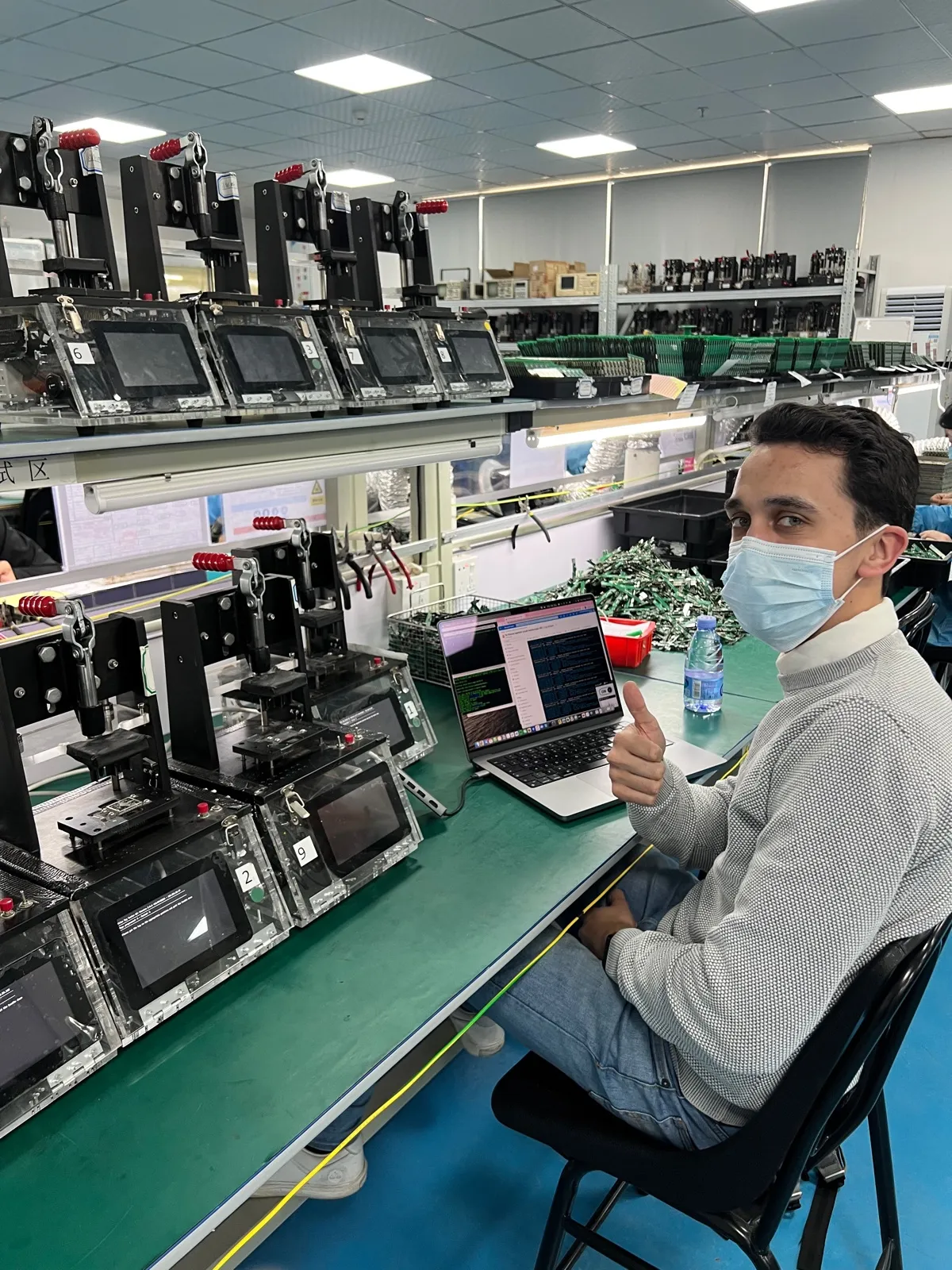
Test stations are part of the production process: agree what each unit must pass and which results to retain.
Let someone try the installation independently
The first experience begins when a customer opens the packaging. Is it clear what is inside? Do they know what to do first? Does the user understand when the device is ready and what an error message means?
This deserves attention in business products too. The person installing the device is not always the person who was involved in development. A logical installation process and a useful manual reduce the need for explanations and lower the risk of misuse.
Test the entire initial experience with someone who does not know the product. Let them unpack it, install it and complete their first task. Take the moments when you feel the need to intervene seriously. They show where the product, documentation or guidance could improve.
Packaging and delivery are part of the product
Packaging protects the product in transit and helps users understand what they are receiving. For a consumer product, the presentation also shapes expectations of quality. Plan this work and its costs early enough.
The same applies to the supply chain. You need to know where components come from, how they are sourced and what lead times and dependencies are involved. A chosen battery or chip may later become difficult to obtain. Discuss with suppliers how you will handle changes and shortages.
Clear agreements are especially valuable when manufacturing takes place at a distance. Define which checks will be carried out and how deviations will be handled. Also investigate sourcing and working conditions in the supply chain in a way that fits your product, suppliers and responsibilities. A low quotation tells you little about those factors.
Decide how you will support the product after delivery
Responsibilities for a connected device continue after the sale. Consider help with installation problems, returns, software maintenance and handling vulnerabilities. Decide who will do this work and how feedback from the field will reach the development team.
You can therefore best assess readiness for sale through evidence from testing, production and use. Have the important risks been investigated? Can the manufacturer deliver the agreed quality? Can the user get started independently? With that foundation in place, the decision to enter the market becomes one you can justify.
Discuss your next step
Our manufacturing service covers the move from pilot to repeatable production. Read about functional production testing and CE certification support.
In this hardware development series
- Hardware development costs: what should you budget?
- Hardware development stages: PoC, EVT, DVT and PVT
- How to test a hardware idea before investing heavily
- Hardware design: size, battery life, performance and cost
'%3e%3cpath%20d='M0.512578%2012.7977C0.512016%2014.8142%201.04302%2016.7831%202.0527%2018.5185L0.416016%2024.448L6.53152%2022.857C8.22299%2023.7706%2010.1181%2024.2494%2012.044%2024.2495H12.0491C18.4067%2024.2495%2023.582%2019.1162%2023.5847%2012.8067C23.586%209.74933%2022.3871%206.87435%2020.2089%204.71138C18.0311%202.54858%2015.1347%201.35686%2012.0486%201.35547C5.6902%201.35547%200.515297%206.48849%200.512672%2012.7977'%20fill='url(%23paint0_linear_1455_10349)'/%3e%3cpath%20d='M0.100313%2012.7941C0.0996563%2014.8831%200.649687%2016.9224%201.69537%2018.72L0%2024.8621L6.33478%2023.214C8.08022%2024.1582%2010.0454%2024.6561%2012.0451%2024.6568H12.0502C18.636%2024.6568%2023.9972%2019.3389%2024%2012.8035C24.0011%209.63629%2022.7591%206.65796%2020.5031%204.4175C18.2468%202.17731%2015.2468%200.942709%2012.0502%200.941406C5.46337%200.941406%200.102938%206.25862%200.100313%2012.7941ZM3.87291%2018.4104L3.63637%2018.0379C2.64206%2016.4691%202.11725%2014.6563%202.118%2012.7948C2.12006%207.36271%206.57544%202.94327%2012.054%202.94327C14.7071%202.94438%2017.2005%203.97062%2019.0759%205.83257C20.9512%207.69471%2021.9831%2010.1701%2021.9824%2012.8028C21.98%2018.2349%2017.5245%2022.6549%2012.0502%2022.6549H12.0463C10.2638%2022.654%208.51569%2022.179%206.99113%2021.2814L6.62831%2021.0679L2.86912%2022.0459L3.87291%2018.4104Z'%20fill='url(%23paint1_linear_1455_10349)'/%3e%3cpath%20d='M9.06383%207.83911C8.84014%207.34581%208.60473%207.33586%208.39202%207.32721C8.21783%207.31976%208.0187%207.32032%207.81977%207.32032C7.62064%207.32032%207.29711%207.39465%207.02364%207.69093C6.74989%207.98748%205.97852%208.70414%205.97852%2010.1617C5.97852%2011.6193%207.04848%2013.028%207.19764%2013.2259C7.34698%2013.4234%209.26323%2016.5103%2012.2981%2017.6978C14.8204%2018.6847%2015.3336%2018.4884%2015.881%2018.4389C16.4285%2018.3896%2017.6477%2017.7225%2017.8964%2017.0306C18.1453%2016.3389%2018.1453%2015.746%2018.0707%2015.6221C17.996%2015.4986%2017.7969%2015.4245%2017.4983%2015.2764C17.1997%2015.1283%2015.7317%2014.4115%2015.458%2014.3126C15.1843%2014.2138%2014.9853%2014.1645%2014.7861%2014.4612C14.587%2014.7573%2014.0152%2015.4245%2013.841%2015.6221C13.6669%2015.8201%2013.4926%2015.8448%2013.1941%2015.6966C12.8953%2015.5479%2011.9337%2015.2355%2010.7929%2014.2263C9.90523%2013.441%209.30598%2012.4712%209.1318%2012.1746C8.95761%2011.8784%209.11314%2011.7178%209.26286%2011.5702C9.39702%2011.4374%209.56155%2011.2242%209.71098%2011.0513C9.85986%2010.8783%209.90955%2010.7548%2010.0091%2010.5573C10.1088%2010.3595%2010.0589%2010.1865%209.98436%2010.0383C9.90955%209.89009%209.32933%208.42488%209.06383%207.83911Z'%20fill='white'/%3e%3c/g%3e%3cdefs%3e%3clinearGradient%20id='paint0_linear_1455_10349'%20x1='1158.85'%20y1='2310.61'%20x2='1158.85'%20y2='1.35547'%20gradientUnits='userSpaceOnUse'%3e%3cstop%20stop-color='%231FAF38'/%3e%3cstop%20offset='1'%20stop-color='%2360D669'/%3e%3c/linearGradient%3e%3clinearGradient%20id='paint1_linear_1455_10349'%20x1='1200'%20y1='2393.01'%20x2='1200'%20y2='0.941406'%20gradientUnits='userSpaceOnUse'%3e%3cstop%20stop-color='%23F9F9F9'/%3e%3cstop%20offset='1'%20stop-color='white'/%3e%3c/linearGradient%3e%3cclipPath%20id='clip0_1455_10349'%3e%3crect%20width='24'%20height='24'%20fill='white'%20transform='translate(0%200.941406)'/%3e%3c/clipPath%3e%3c/defs%3e%3c/svg%3e)