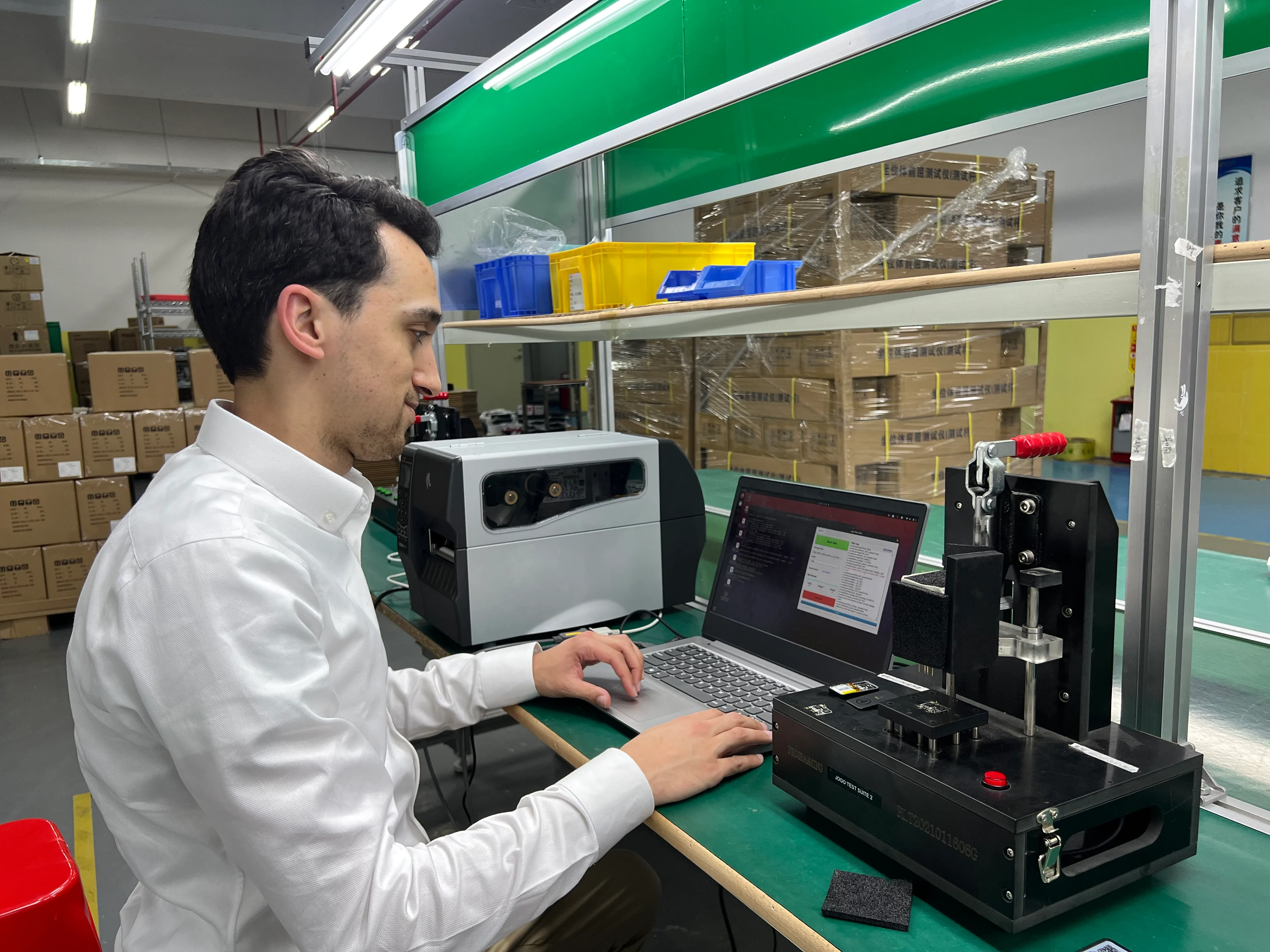
Between the moment a circuit board comes out of the soldering oven and the moment a finished device goes into a box, it gets tested four times.
First a camera looks at it. Then a bed of pins probes it. Then it's powered on and made to do its job. And finally, after it's assembled into its housing, the complete product is checked one last time before the box is sealed.
The four stages have names: AOI, ICT, FCT and EOL. This post explains what each one catches, why skipping one is how you end up with a pallet of dead units, and how we run this at Insyght, including the two measurements most factories don't take and IoT products fail on later.
The principle behind all of it: you want to catch a problem at unit ten, not at unit ten thousand.
Why so much testing for one small board
Soldering is a delicate process. A machine places hundreds of components on a board, then the board goes through an oven and every joint has to form correctly. Mostly they do. Sometimes they don't: a part sits slightly rotated, a joint doesn't close, or two neighbouring pins get bridged by a drop of solder.
One bad joint can kill the whole device. And the cost of finding it grows at every step. On the line it costs seconds. In your warehouse it costs a repair loop. At your customer it costs a return, a replacement, and a bit of your reputation.
That's the entire logic of production testing: move the discovery as early as possible.
The four stages
AOI, automated optical inspection. A camera system photographs every freshly soldered board and compares it against a known-good reference. It catches what's visible: missing parts, wrong orientation, obvious solder problems. It takes seconds and touches nothing.
ICT, in-circuit test. The board is pressed onto a bed of nails: a plate of spring-loaded pins that contact test points on the board. Each pin electrically checks a component or connection, usually before the board is ever powered on. AOI sees the surface; ICT sees the circuit. ICT data is also the first place a pattern shows up. If thirty boards fail on the same capacitor, the problem isn't thirty capacitors. It's placement, paste, or a bad reel from the supplier.
FCT, functional circuit test. Now the board gets power and has to behave. Firmware boots, sensors respond, the radio transmits, the voltages sit where they should. This is the first time the board is tested as a working system instead of a collection of parts.
EOL, end-of-line test. The board goes into its enclosure, the battery is connected, buttons and seals go on. Then the finished product gets its final check. This one matters more than people expect, because assembly itself breaks things: a battery connector that didn't seat, a button that binds against the housing, an antenna that behaved fine in open air and differently inside plastic.
Where IoT products are different
A connected device can pass every stage above and still come back as a warranty return six months later. Two measurements predict it, and most lines don't take either.
Radio performance inside the enclosure. An antenna is tuned for its surroundings. Plastic, screws, a battery pressed against it, a hand around it: all of that detunes it. A tracker that transmits happily as a bare board can lose enough sensitivity inside its housing that it drops connection at the edge of coverage. For the JOGO insole sensor the enclosure was a human foot, and we tested with that in the loop.
Sleep current. A battery-powered device spends almost its whole life asleep. Design for four years of battery means sleeping at a few microamps. One marginal component can turn 4 µA into 40 µA, and every unit with that flaw dies in months instead of years. It still passes a basic "does it work" test. It fails in the field.
So our functional tests measure both, per unit, with limits. Not "does the radio connect" but "how much power at which sensitivity". Not "does it turn off" but "how many microamps while off".
What "ATE" actually means
ATE is automated test equipment: the umbrella term for fixtures, instruments and software that run these tests without a person doing each step by hand.
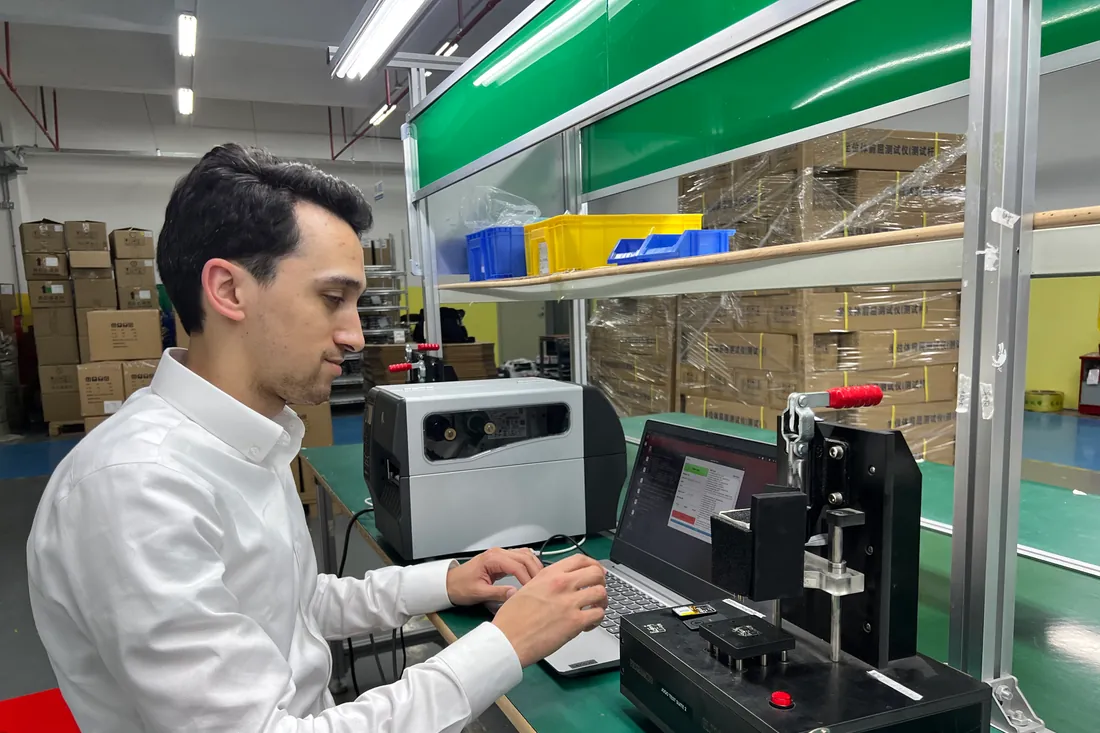
For us that's PogoBot, the fixture platform we built from ready-made blocks for GPS, LTE, BLE, Wi-Fi and SWD/JTAG programming. A new product mostly means recombining blocks instead of engineering a fixture from zero. Test sequences are Python scripts, versioned in Git like any other code. The operator presses one button; the fixture programs the board, runs the sequence, and logs every measurement.
At end-of-line we add a small station app: scan the unit's QR code, take a photo for the record, press the buttons, run a Bluetooth check, then put the device into shipping mode, a deep-sleep state so the battery survives the warehouse and the shelf. The unit is sealed, labelled and done.
The part most factories skip: watching the line
Every measurement from every unit streams into Insyght Console, our own dashboard. Not because collecting data is impressive, but because of what live data lets you see: drift.
A production line rarely fails suddenly. It drifts. A test that passed with margin this morning passes barely this afternoon. The units still say PASS, so a pass/fail report shows nothing. But the distribution is sliding toward the limit, and tomorrow's batch crosses it. Statisticians call the metric Cpk; the plain version is "how comfortably are we passing". When that number falls, we get an alert while the line is still running and there is still time to intervene.
That's how you hold a first-pass yield above 95%, which is our benchmark on production runs: not by testing harder at the end, but by noticing earlier.
FAQ
What's the difference between ICT and FCT? ICT checks the parts: is every component soldered on correctly, before power-up. FCT checks the product: powered on, running firmware, doing its job. ICT finds a bridged pin; FCT finds a sensor that reads wrong.
Do small production runs need all four stages? Not always. Below roughly a thousand units, a dedicated ICT bed of nails is often not worth its cost, and AOI plus a thorough FCT covers you. FCT and EOL are the two we never skip, at any volume: they're the only stages that test the product the way a customer will use it.
What is first-pass yield? The percentage of units that pass every test the first time, with no rework or retest. It's the honest number for how healthy a line is. A 98% yield achieved through retesting is not the same thing.
What is shipping mode? A deep-sleep state the device is put into at the end of the line, so the battery isn't drained between the factory and the customer's first power-on. A device can sit in a warehouse for months; without shipping mode, it arrives dead.
Planning a production run and want the test plan designed before the tooling, not after? Talk to us, or see how we run manufacturing end to end.
'%3e%3cpath%20d='M0.512578%2012.7977C0.512016%2014.8142%201.04302%2016.7831%202.0527%2018.5185L0.416016%2024.448L6.53152%2022.857C8.22299%2023.7706%2010.1181%2024.2494%2012.044%2024.2495H12.0491C18.4067%2024.2495%2023.582%2019.1162%2023.5847%2012.8067C23.586%209.74933%2022.3871%206.87435%2020.2089%204.71138C18.0311%202.54858%2015.1347%201.35686%2012.0486%201.35547C5.6902%201.35547%200.515297%206.48849%200.512672%2012.7977'%20fill='url(%23paint0_linear_1455_10349)'/%3e%3cpath%20d='M0.100313%2012.7941C0.0996563%2014.8831%200.649687%2016.9224%201.69537%2018.72L0%2024.8621L6.33478%2023.214C8.08022%2024.1582%2010.0454%2024.6561%2012.0451%2024.6568H12.0502C18.636%2024.6568%2023.9972%2019.3389%2024%2012.8035C24.0011%209.63629%2022.7591%206.65796%2020.5031%204.4175C18.2468%202.17731%2015.2468%200.942709%2012.0502%200.941406C5.46337%200.941406%200.102938%206.25862%200.100313%2012.7941ZM3.87291%2018.4104L3.63637%2018.0379C2.64206%2016.4691%202.11725%2014.6563%202.118%2012.7948C2.12006%207.36271%206.57544%202.94327%2012.054%202.94327C14.7071%202.94438%2017.2005%203.97062%2019.0759%205.83257C20.9512%207.69471%2021.9831%2010.1701%2021.9824%2012.8028C21.98%2018.2349%2017.5245%2022.6549%2012.0502%2022.6549H12.0463C10.2638%2022.654%208.51569%2022.179%206.99113%2021.2814L6.62831%2021.0679L2.86912%2022.0459L3.87291%2018.4104Z'%20fill='url(%23paint1_linear_1455_10349)'/%3e%3cpath%20d='M9.06383%207.83911C8.84014%207.34581%208.60473%207.33586%208.39202%207.32721C8.21783%207.31976%208.0187%207.32032%207.81977%207.32032C7.62064%207.32032%207.29711%207.39465%207.02364%207.69093C6.74989%207.98748%205.97852%208.70414%205.97852%2010.1617C5.97852%2011.6193%207.04848%2013.028%207.19764%2013.2259C7.34698%2013.4234%209.26323%2016.5103%2012.2981%2017.6978C14.8204%2018.6847%2015.3336%2018.4884%2015.881%2018.4389C16.4285%2018.3896%2017.6477%2017.7225%2017.8964%2017.0306C18.1453%2016.3389%2018.1453%2015.746%2018.0707%2015.6221C17.996%2015.4986%2017.7969%2015.4245%2017.4983%2015.2764C17.1997%2015.1283%2015.7317%2014.4115%2015.458%2014.3126C15.1843%2014.2138%2014.9853%2014.1645%2014.7861%2014.4612C14.587%2014.7573%2014.0152%2015.4245%2013.841%2015.6221C13.6669%2015.8201%2013.4926%2015.8448%2013.1941%2015.6966C12.8953%2015.5479%2011.9337%2015.2355%2010.7929%2014.2263C9.90523%2013.441%209.30598%2012.4712%209.1318%2012.1746C8.95761%2011.8784%209.11314%2011.7178%209.26286%2011.5702C9.39702%2011.4374%209.56155%2011.2242%209.71098%2011.0513C9.85986%2010.8783%209.90955%2010.7548%2010.0091%2010.5573C10.1088%2010.3595%2010.0589%2010.1865%209.98436%2010.0383C9.90955%209.89009%209.32933%208.42488%209.06383%207.83911Z'%20fill='white'/%3e%3c/g%3e%3cdefs%3e%3clinearGradient%20id='paint0_linear_1455_10349'%20x1='1158.85'%20y1='2310.61'%20x2='1158.85'%20y2='1.35547'%20gradientUnits='userSpaceOnUse'%3e%3cstop%20stop-color='%231FAF38'/%3e%3cstop%20offset='1'%20stop-color='%2360D669'/%3e%3c/linearGradient%3e%3clinearGradient%20id='paint1_linear_1455_10349'%20x1='1200'%20y1='2393.01'%20x2='1200'%20y2='0.941406'%20gradientUnits='userSpaceOnUse'%3e%3cstop%20stop-color='%23F9F9F9'/%3e%3cstop%20offset='1'%20stop-color='white'/%3e%3c/linearGradient%3e%3cclipPath%20id='clip0_1455_10349'%3e%3crect%20width='24'%20height='24'%20fill='white'%20transform='translate(0%200.941406)'/%3e%3c/clipPath%3e%3c/defs%3e%3c/svg%3e)