Every football wearable has to answer one question before anything else: where do you put it?
The market had tried most of the options already. A pocket in the shin guard. A wristband. A GPS vest on the back or the chest. They all work, and they all sit a long way from the thing you actually want to measure. A vest can tell you a player ran six kilometres. It can't tell you much about how they struck the ball.
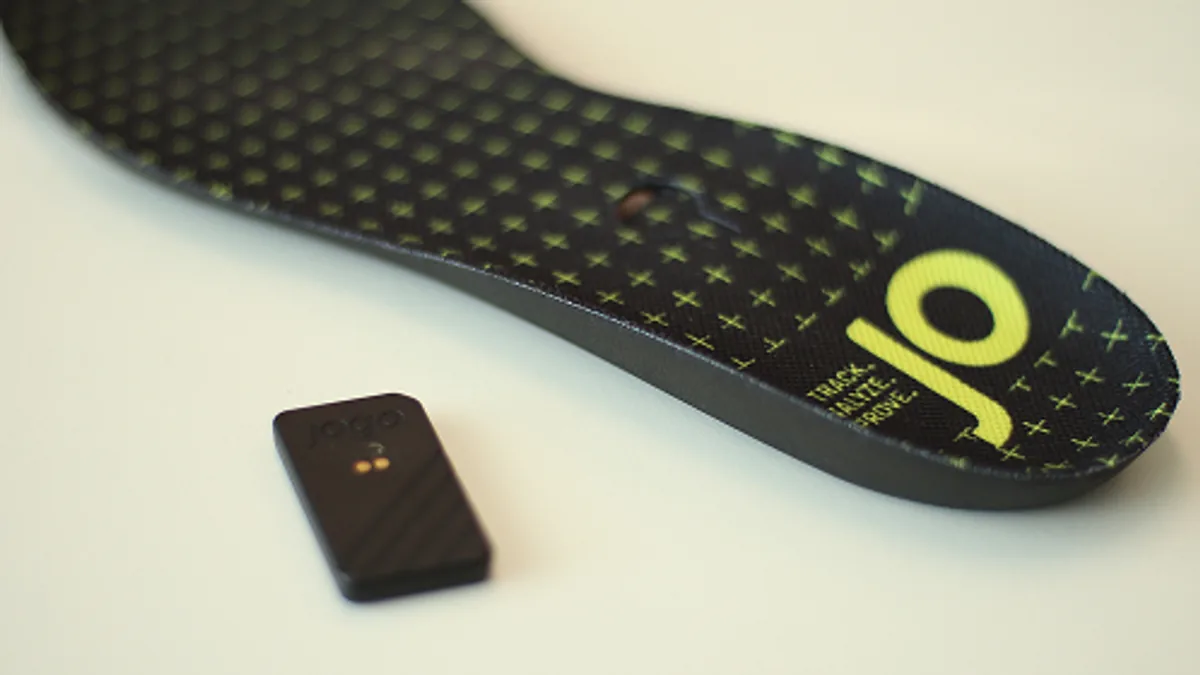
JOGO came to us with the answer: put it in the insole. That's where the contact happens. And because football is played with two feet, you need one in each shoe. A single sensor gives you half a player.
It was the right product call. It also created every hard problem we spent the next months solving.
What we did and what the factory did
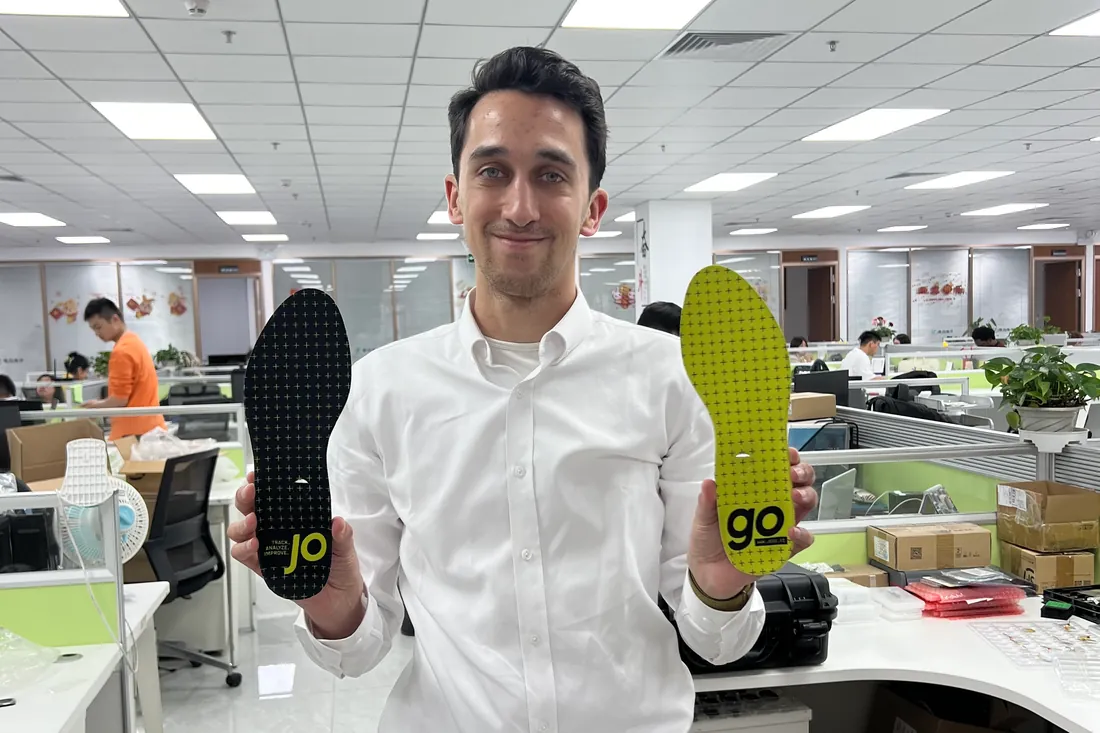
JOGO had the idea and the platform. We did the product concept, the electronics and PCB design, the mechanical and packaging design, the app design, the firmware and the on-device algorithms.
An ODM in China handled final assembly and integration, part sourcing, and the manufacturability work that turns a design into something a line can actually build.
The product shipped, and JOGO was later acquired by football media platform 433.
The constraint that shapes everything: you can't feel it
Anyone who has walked a kilometre with a small stone in their shoe knows how sensitive the sole of the foot is. A player who notices the sensor stops trusting the boot, and a boot you don't trust comes off.
So the brief was never "make it small". It was make it invisible to the wearer, while keeping enough battery, enough radio range and enough processing power to be useful, at a price a youth player's parents will actually pay.
Those pull against each other constantly. More battery means more thickness. More processing means more current. Lower cost takes away the tricks you'd use to solve either.
We worked on it from two sides at once. On the electronics, an ultra-thin PCB paired with a very flat battery, so the sensor was small in every dimension rather than just two of them. Every millimetre out of the stack-up was a millimetre we didn't have to hide.
The mechanical half turned out to be harder. Insole comfort is deeply subjective. Some players want a firm sole, others want a soft one, and the same insole can feel right to one tester and wrong to the next. There's no spec sheet for that. So we prototyped a lot: shapes, thicknesses, shore hardness, cavity position, until we had a design that held up across a range of preferences instead of being tuned to one person's foot.
What came out is an insole with a cavity carrying the electronics that still feels like an insole.
Charging it without ruining it
A sealed insole is comfortable and useless. Players have to charge it, in a hallway, without thinking about it.
We put a small cutout in the insole with a lid that opens to expose the contacts. A magnetic charger snaps on, and the charging hand takes both insoles at once. Charging is one action instead of a chore you repeat per shoe.
Getting 2.4 GHz through a human foot
Bluetooth at 2.4 GHz is absorbed enthusiastically by water, and a foot inside a boot is mostly water wrapped in leather. On paper, under the wearer is about the worst place you could put an antenna.
We designed a proprietary antenna together with a specialist antenna partner and the ODM. Enough clearance to the PCB, tuned for the loaded condition rather than the bench, and cheap enough to survive the BOM review.
Measured range on the finished product was roughly half a pitch, with the sensor in the shoe and the shoe on a player. That's a good number for an antenna in that position. More to the point, it was enough, because of how we built the software.
Everything runs on the device
You can't play football with a phone in your pocket. That single fact rules out the architecture most fitness wearables use, where the sensor streams raw data and the phone does the thinking.
JOGO does the thinking itself. From a 6-axis IMU, the firmware works out distance covered, speed over time, activity level, shot detection and classification separating a pass from a lob from a strike, shot power expressed as ball speed, and gait analysis across both feet.
The two insoles also talk to each other. Each sensor knows what the other foot is doing, which is what makes real gait analysis possible instead of two independent step counters. When the phone comes back in range, they sync the full time series across, so the player gets their session as a history rather than a snapshot.
Getting all of that out of a 6-axis IMU, inside the power budget of a battery thin enough to hide under a foot, is the part of this project we're proudest of.
Ground truth from a camera
Classifying a shot is one problem. Telling a player how fast the ball actually travelled is another, and it's the number they care about most.
So we measured it. We took a lot of shots at goal, filmed them, worked out the true ball speed from the footage, and used that to train the algorithm that turns IMU signals into football speeds. When the app tells a player their strike was fast, that number traces back to real measured balls, not a scaling factor someone liked the look of.
From working prototype to production units
A prototype that works on your desk and a product that works in a box on a shelf are separated by a lot of unglamorous work. This is where the ODM partnership mattered, and where the friction lives.
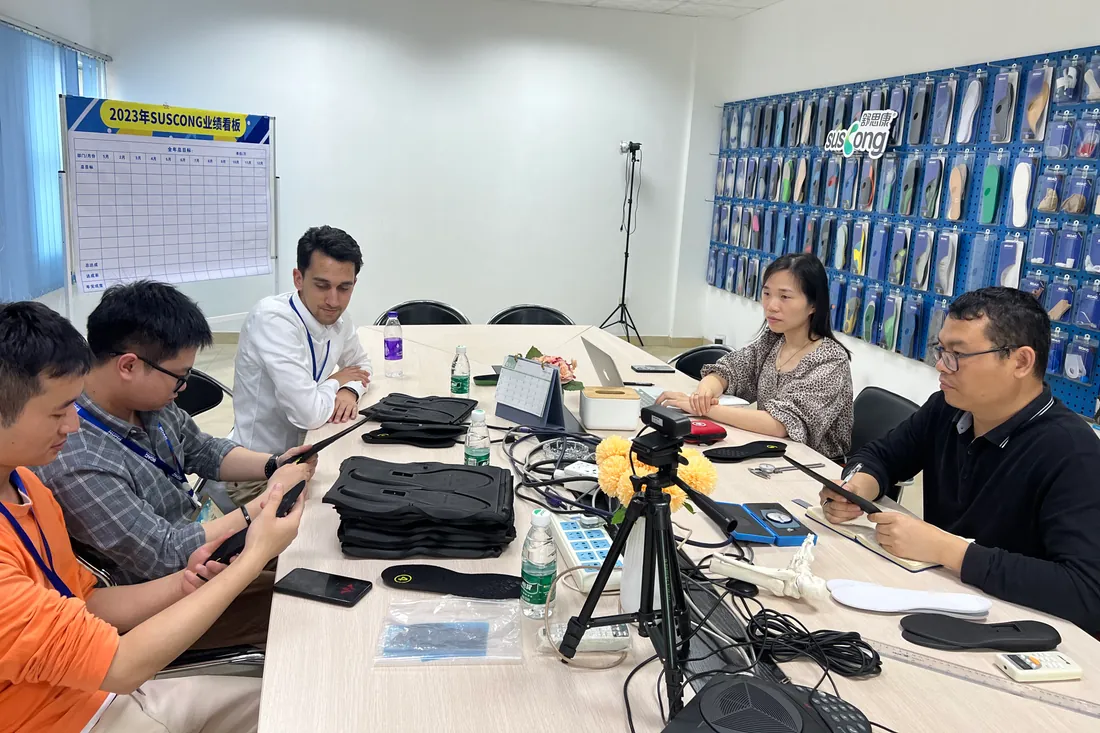
The hard part of working with a factory on another continent isn't the drawings. It's transferring a standard of quality: making sure the parts come together properly, the finish is right, the unboxing feels like the product you designed, and every unit that ships behaves like the one you approved.
So we built the infrastructure for it. A custom PCBA test fixture, so every unit was tested during production rather than sampled. A custom label per unit, printed with a PIN and a QR code, so pairing a left and right shoe to the app was a scan instead of a support ticket. And an instruction manual carrying the right certification labelling and product identification.
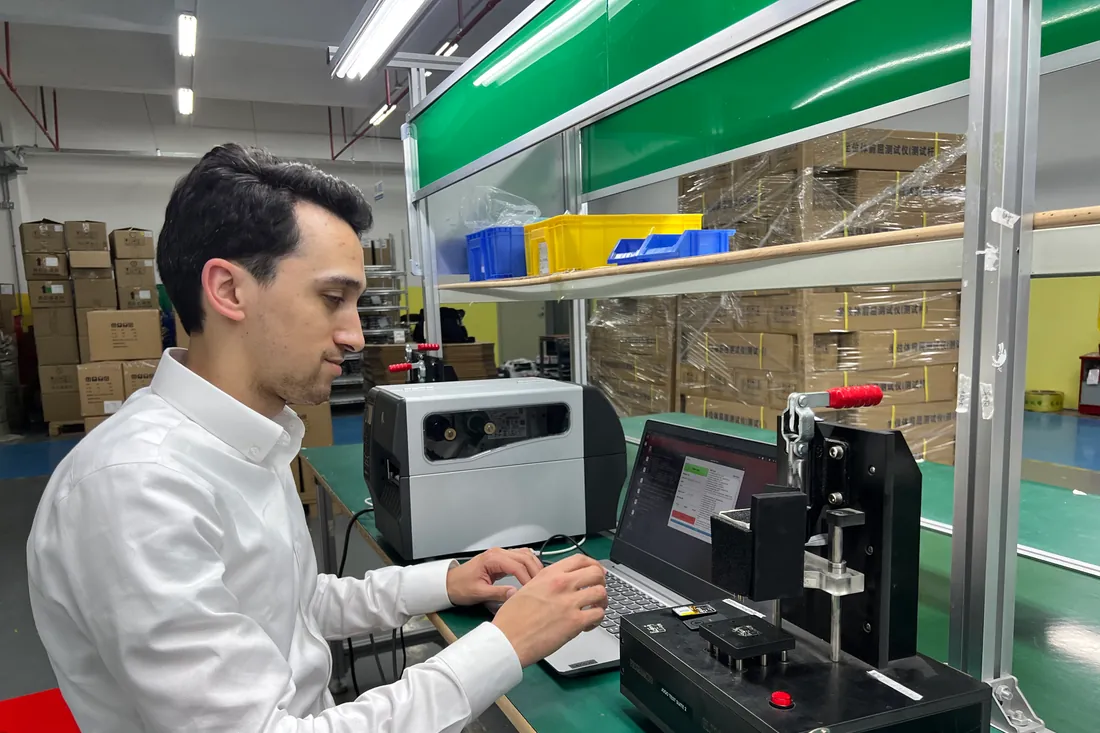
Quality control is not the exciting part of a case study. It's the reason the reviews are good.
More than a sensor
JOGO was never only hardware. The platform around it had team signup and coach and squad management, so a team could use it together rather than as a set of individuals.
It also had a camera-based training layer. A player could put their phone on the floor at home and the app would watch them do drills: keeping the ball up with a live counter, and other exercises that turned solo practice into something with a score attached. Gamified football, for the hours when there's no team and no pitch.
That combination, hardware close to the ball plus a platform that made the data mean something, is what made the company worth acquiring. 433 came to JOGO after seeing the product working.
"We had this idea for a sensor that fits inside a football shoe and tracks your performance in real time. Insyght took it from concept all the way to a working product: the hardware, the ML firmware, production, everything. What sold us is that they had done it before and knew what to do. The product ended up being picked up by 433 and scaled further."
David Dwinger, Founder at JOGO (now 433)
What we took from it
Put the sensor where the signal is, then solve the consequences. The insole was the harder engineering choice and the better product choice. Comfort, antenna performance and thickness were all downstream problems, and they were all solvable.
Design the architecture around how the product is actually used. No phone on the pitch meant on-device algorithms and syncing when you get the chance. That constraint came from football, not from a datasheet.
And build the production tooling as part of the product. Test fixtures, pairing labels and documentation are the difference between a design that works and a product that ships.
Building a connected product with a hard physical constraint? That's the work we do: electronics, firmware, algorithms and the factory hand-off, end to end.
Talk to us about your product, or read how we built MedeMeter, a solar-powered sensor with its own on-device AI.
'%3e%3cpath%20d='M0.512578%2012.7977C0.512016%2014.8142%201.04302%2016.7831%202.0527%2018.5185L0.416016%2024.448L6.53152%2022.857C8.22299%2023.7706%2010.1181%2024.2494%2012.044%2024.2495H12.0491C18.4067%2024.2495%2023.582%2019.1162%2023.5847%2012.8067C23.586%209.74933%2022.3871%206.87435%2020.2089%204.71138C18.0311%202.54858%2015.1347%201.35686%2012.0486%201.35547C5.6902%201.35547%200.515297%206.48849%200.512672%2012.7977'%20fill='url(%23paint0_linear_1455_10349)'/%3e%3cpath%20d='M0.100313%2012.7941C0.0996563%2014.8831%200.649687%2016.9224%201.69537%2018.72L0%2024.8621L6.33478%2023.214C8.08022%2024.1582%2010.0454%2024.6561%2012.0451%2024.6568H12.0502C18.636%2024.6568%2023.9972%2019.3389%2024%2012.8035C24.0011%209.63629%2022.7591%206.65796%2020.5031%204.4175C18.2468%202.17731%2015.2468%200.942709%2012.0502%200.941406C5.46337%200.941406%200.102938%206.25862%200.100313%2012.7941ZM3.87291%2018.4104L3.63637%2018.0379C2.64206%2016.4691%202.11725%2014.6563%202.118%2012.7948C2.12006%207.36271%206.57544%202.94327%2012.054%202.94327C14.7071%202.94438%2017.2005%203.97062%2019.0759%205.83257C20.9512%207.69471%2021.9831%2010.1701%2021.9824%2012.8028C21.98%2018.2349%2017.5245%2022.6549%2012.0502%2022.6549H12.0463C10.2638%2022.654%208.51569%2022.179%206.99113%2021.2814L6.62831%2021.0679L2.86912%2022.0459L3.87291%2018.4104Z'%20fill='url(%23paint1_linear_1455_10349)'/%3e%3cpath%20d='M9.06383%207.83911C8.84014%207.34581%208.60473%207.33586%208.39202%207.32721C8.21783%207.31976%208.0187%207.32032%207.81977%207.32032C7.62064%207.32032%207.29711%207.39465%207.02364%207.69093C6.74989%207.98748%205.97852%208.70414%205.97852%2010.1617C5.97852%2011.6193%207.04848%2013.028%207.19764%2013.2259C7.34698%2013.4234%209.26323%2016.5103%2012.2981%2017.6978C14.8204%2018.6847%2015.3336%2018.4884%2015.881%2018.4389C16.4285%2018.3896%2017.6477%2017.7225%2017.8964%2017.0306C18.1453%2016.3389%2018.1453%2015.746%2018.0707%2015.6221C17.996%2015.4986%2017.7969%2015.4245%2017.4983%2015.2764C17.1997%2015.1283%2015.7317%2014.4115%2015.458%2014.3126C15.1843%2014.2138%2014.9853%2014.1645%2014.7861%2014.4612C14.587%2014.7573%2014.0152%2015.4245%2013.841%2015.6221C13.6669%2015.8201%2013.4926%2015.8448%2013.1941%2015.6966C12.8953%2015.5479%2011.9337%2015.2355%2010.7929%2014.2263C9.90523%2013.441%209.30598%2012.4712%209.1318%2012.1746C8.95761%2011.8784%209.11314%2011.7178%209.26286%2011.5702C9.39702%2011.4374%209.56155%2011.2242%209.71098%2011.0513C9.85986%2010.8783%209.90955%2010.7548%2010.0091%2010.5573C10.1088%2010.3595%2010.0589%2010.1865%209.98436%2010.0383C9.90955%209.89009%209.32933%208.42488%209.06383%207.83911Z'%20fill='white'/%3e%3c/g%3e%3cdefs%3e%3clinearGradient%20id='paint0_linear_1455_10349'%20x1='1158.85'%20y1='2310.61'%20x2='1158.85'%20y2='1.35547'%20gradientUnits='userSpaceOnUse'%3e%3cstop%20stop-color='%231FAF38'/%3e%3cstop%20offset='1'%20stop-color='%2360D669'/%3e%3c/linearGradient%3e%3clinearGradient%20id='paint1_linear_1455_10349'%20x1='1200'%20y1='2393.01'%20x2='1200'%20y2='0.941406'%20gradientUnits='userSpaceOnUse'%3e%3cstop%20stop-color='%23F9F9F9'/%3e%3cstop%20offset='1'%20stop-color='white'/%3e%3c/linearGradient%3e%3cclipPath%20id='clip0_1455_10349'%3e%3crect%20width='24'%20height='24'%20fill='white'%20transform='translate(0%200.941406)'/%3e%3c/clipPath%3e%3c/defs%3e%3c/svg%3e)