You have an idea for a smart product. Perhaps a sensor, a wearable or a tracker. You know which problem you want to solve, and you are looking for someone to build it. Before long, the question comes up: how much will this cost?
For the kind of custom IoT products we develop, I often mention a range of €50,000 to €150,000 in an initial conversation. This is an estimate based on experience, intended to start a realistic discussion about the investment. The complexity of the product, the level of innovation and the uncertainties we need to investigate all make a significant difference. Some projects fall outside this range.
Just as important is what that investment actually covers. A development budget and the total amount needed to bring a product to market are two different budgets. You need to consider both from the start.

Separate budget categories, not a percentage split or a fixed quote.
The range is a planning indication for custom connected-product development, not a fixed offer or an all-in launch budget. Confirm the included work, VAT treatment and exclusions in the project proposal.
Why some products take much more work
A Bluetooth tag with one sensor and a clear application is a relatively straightforward starting point. That is especially true when we use familiar technology and the size and battery life requirements are achievable. A product like this is more likely to sit towards the lower end of the range.
Combine LoRa, LTE, Bluetooth and Wi-Fi in a small enclosure, with long battery life and demanding range requirements, and the challenge changes. The components have to work together. They share space, a power supply and a physical environment. An antenna choice can affect the enclosure. An additional connection also requires work on firmware and testing.
Costs therefore depend on these interdependencies too. The more requirements affect one another, the more design work and investigation may be needed to find a combination that works well.
Start with the essential value for your user
My first question is what the product actually needs to do, for whom and under what conditions. What is the minimum value it must deliver to be worthwhile?
We first separate the essential job from optional features. A first version needs enough functionality to solve that job and demonstrate its value in use.
Suppose you are developing a sensor that occasionally needs to report a change. Do you also need it to transmit data continuously? Perhaps that is useful. Perhaps it mainly adds development work, power consumption and operating costs. You want to make that decision before the extra feature becomes a fixed part of the design.
Separate the different types of cost
A useful budget shows where the money will go. Think about feasibility studies, electronics, firmware, the enclosure and prototypes. If your product needs an app or a cloud platform, it should also be clear who will develop it and what budget has been allocated.
There are further costs involved in actually delivering the product. Certification, production tooling, test fixtures and setting up quality control are easy to underestimate. Packaging and manuals belong on that list too. The first production run then requires money for components and assembly, often before you have sold the products.
After delivery, connectivity, hosting, maintenance and support costs may continue. What a development proposal includes varies from project to project, so ask for an explicit scope. Comparing total prices alone tells you very little if one proposal covers more work than another.
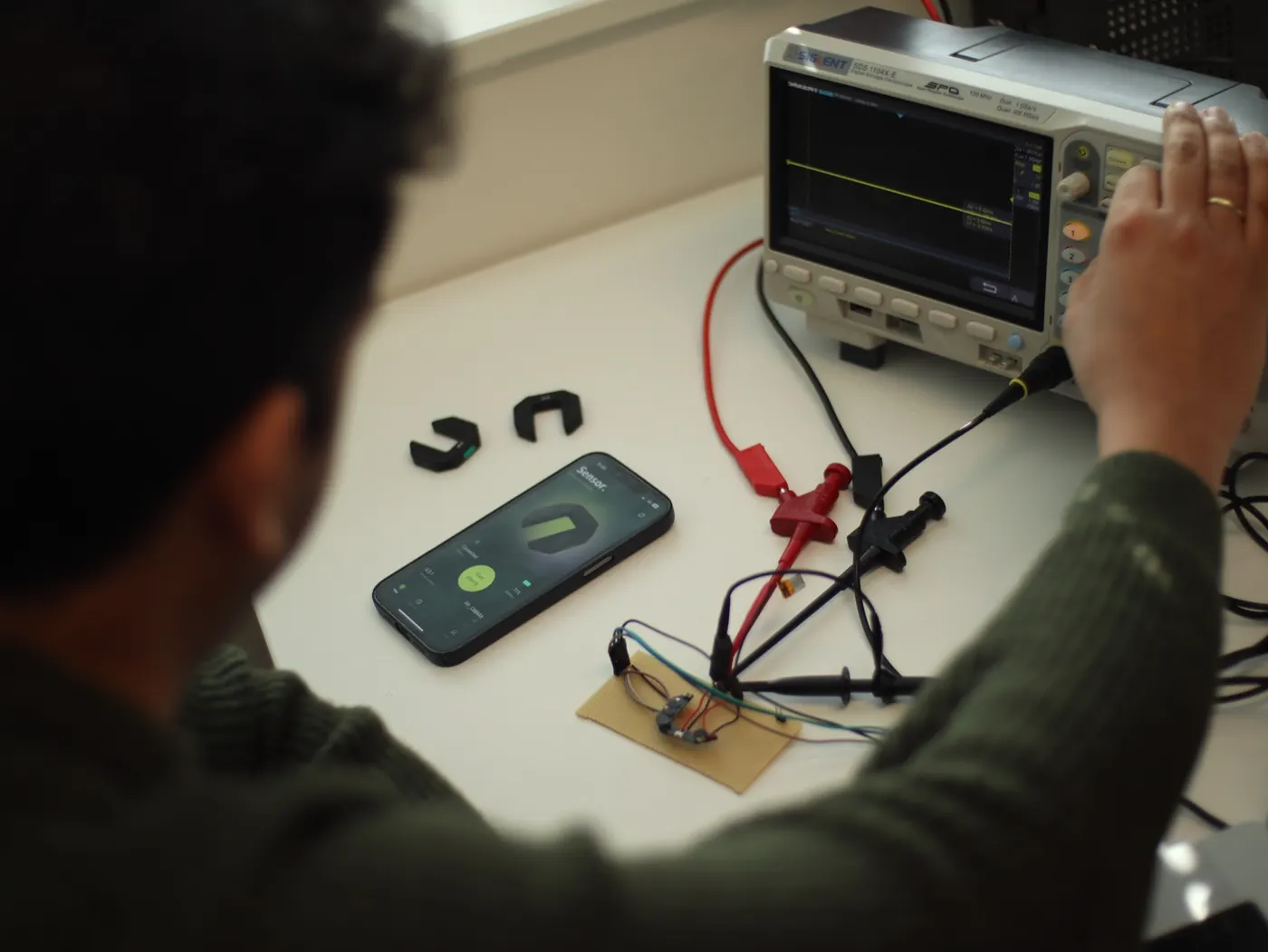
A test setup helps turn an assumption into measurements before committing to a complete design.
A low unit cost also requires investment
I regularly hear that a product should ultimately cost just ten or twenty euros. That is a useful target if it fits your market, but first you need to define what the price covers. Are you talking about components, a tested product leaving the factory or the final selling price?
Production volume matters too. The investment in a mould or test fixture has to be recovered across the units you produce. Use volumes you can justify. An attractive unit cost at a hundred thousand units is not much help if you first need to finance a small production run.
Sourcing cheaply overseas also means paying attention to how you ensure quality. You need to know how products are tested, who assesses deviations and what happens if a shipment does not meet the agreed requirements. That work belongs in your plan.
You invest one step at a time
The €50,000 to €150,000 does not have to be spent in full on day one. A hardware project progresses through stages. You start by investigating feasibility, build an initial prototype and use what you learn to assess the next investment.
For projects like these, I often allow six to twelve months, and sometimes eighteen months. That is an indication of the overall lead time, rather than a fixed schedule for every product. During that period, you make several decisions about whether to continue, adjust the approach or stop.
An investigation may also show that a combination of requirements is not sufficiently feasible. That is valuable information to have before investing much further. Go into your first development discussion with a clearly defined user, a specific application and a realistic budget. Then ask which uncertainty you need to resolve first and what that step will cost. This turns a large investment into a series of decisions you can assess.
Discuss your next step
Planning a complete device? Discuss the development scope. For a board-only brief, read our PCB design cost guide.
'%3e%3cpath%20d='M0.512578%2012.7977C0.512016%2014.8142%201.04302%2016.7831%202.0527%2018.5185L0.416016%2024.448L6.53152%2022.857C8.22299%2023.7706%2010.1181%2024.2494%2012.044%2024.2495H12.0491C18.4067%2024.2495%2023.582%2019.1162%2023.5847%2012.8067C23.586%209.74933%2022.3871%206.87435%2020.2089%204.71138C18.0311%202.54858%2015.1347%201.35686%2012.0486%201.35547C5.6902%201.35547%200.515297%206.48849%200.512672%2012.7977'%20fill='url(%23paint0_linear_1455_10349)'/%3e%3cpath%20d='M0.100313%2012.7941C0.0996563%2014.8831%200.649687%2016.9224%201.69537%2018.72L0%2024.8621L6.33478%2023.214C8.08022%2024.1582%2010.0454%2024.6561%2012.0451%2024.6568H12.0502C18.636%2024.6568%2023.9972%2019.3389%2024%2012.8035C24.0011%209.63629%2022.7591%206.65796%2020.5031%204.4175C18.2468%202.17731%2015.2468%200.942709%2012.0502%200.941406C5.46337%200.941406%200.102938%206.25862%200.100313%2012.7941ZM3.87291%2018.4104L3.63637%2018.0379C2.64206%2016.4691%202.11725%2014.6563%202.118%2012.7948C2.12006%207.36271%206.57544%202.94327%2012.054%202.94327C14.7071%202.94438%2017.2005%203.97062%2019.0759%205.83257C20.9512%207.69471%2021.9831%2010.1701%2021.9824%2012.8028C21.98%2018.2349%2017.5245%2022.6549%2012.0502%2022.6549H12.0463C10.2638%2022.654%208.51569%2022.179%206.99113%2021.2814L6.62831%2021.0679L2.86912%2022.0459L3.87291%2018.4104Z'%20fill='url(%23paint1_linear_1455_10349)'/%3e%3cpath%20d='M9.06383%207.83911C8.84014%207.34581%208.60473%207.33586%208.39202%207.32721C8.21783%207.31976%208.0187%207.32032%207.81977%207.32032C7.62064%207.32032%207.29711%207.39465%207.02364%207.69093C6.74989%207.98748%205.97852%208.70414%205.97852%2010.1617C5.97852%2011.6193%207.04848%2013.028%207.19764%2013.2259C7.34698%2013.4234%209.26323%2016.5103%2012.2981%2017.6978C14.8204%2018.6847%2015.3336%2018.4884%2015.881%2018.4389C16.4285%2018.3896%2017.6477%2017.7225%2017.8964%2017.0306C18.1453%2016.3389%2018.1453%2015.746%2018.0707%2015.6221C17.996%2015.4986%2017.7969%2015.4245%2017.4983%2015.2764C17.1997%2015.1283%2015.7317%2014.4115%2015.458%2014.3126C15.1843%2014.2138%2014.9853%2014.1645%2014.7861%2014.4612C14.587%2014.7573%2014.0152%2015.4245%2013.841%2015.6221C13.6669%2015.8201%2013.4926%2015.8448%2013.1941%2015.6966C12.8953%2015.5479%2011.9337%2015.2355%2010.7929%2014.2263C9.90523%2013.441%209.30598%2012.4712%209.1318%2012.1746C8.95761%2011.8784%209.11314%2011.7178%209.26286%2011.5702C9.39702%2011.4374%209.56155%2011.2242%209.71098%2011.0513C9.85986%2010.8783%209.90955%2010.7548%2010.0091%2010.5573C10.1088%2010.3595%2010.0589%2010.1865%209.98436%2010.0383C9.90955%209.89009%209.32933%208.42488%209.06383%207.83911Z'%20fill='white'/%3e%3c/g%3e%3cdefs%3e%3clinearGradient%20id='paint0_linear_1455_10349'%20x1='1158.85'%20y1='2310.61'%20x2='1158.85'%20y2='1.35547'%20gradientUnits='userSpaceOnUse'%3e%3cstop%20stop-color='%231FAF38'/%3e%3cstop%20offset='1'%20stop-color='%2360D669'/%3e%3c/linearGradient%3e%3clinearGradient%20id='paint1_linear_1455_10349'%20x1='1200'%20y1='2393.01'%20x2='1200'%20y2='0.941406'%20gradientUnits='userSpaceOnUse'%3e%3cstop%20stop-color='%23F9F9F9'/%3e%3cstop%20offset='1'%20stop-color='white'/%3e%3c/linearGradient%3e%3cclipPath%20id='clip0_1455_10349'%3e%3crect%20width='24'%20height='24'%20fill='white'%20transform='translate(0%200.941406)'/%3e%3c/clipPath%3e%3c/defs%3e%3c/svg%3e)